
5 Agile Scaling Frameworks Compared: Which One Should You Use?
Toptal’s Agile scaling series is designed to guide project managers in their team expansion efforts. In this first installment, project manager Kamil Imański breaks down popular scaling frameworks to help you make the best choice.

Toptal’s Agile scaling series is designed to guide project managers in their team expansion efforts. In this first installment, project manager Kamil Imański breaks down popular scaling frameworks to help you make the best choice.

Kamil is an Agile project manager and Scrum master with a background in business analysis and change management. He has extensive experience leading teams and implementing Agile scaling practices at international companies, including BAE Systems, which is an FTSE100 company and the largest defense contractor in Europe. He is a certified Lean Six Sigma Black Belt, PMP, and PMI-ACP.
Previously At

This article is part one of Toptal’s scaling Agile series, designed to guide project managers in their team expansion efforts. The next installment, “Agile Scaling: SAFe Best Practices for Scrum Masters,” offers practical advice on facilitating events in SAFe.
Picture this: At the start of a new development project, you assemble a single, effective, cross-functional team and ensure they become proficient in Agile. They hit their stride. Over time, demand for the product grows, and the backlog becomes more complex. Eventually, one team is no longer enough. You and your stakeholders agree that it’s time to expand, but how do you keep your teams running smoothly when this happens?
A scalable Agile framework enables multiple teams to maintain their agility while coordinating work across increasingly complex delivery environments. To do so successfully, however, you need to select the right Agile framework, and there are several to choose from. Choosing the wrong framework can disrupt productivity and result in significant financial repercussions.
The framework best suited to your organization will vary depending on factors such as available funding, organizational structure, and product complexity.
When Should You Scale?
There are a number of key criteria to meet before you should consider scaling:
Can you manage the development with only one team?
Implementing scaled Agile frameworks can be complex and time-consuming, so don’t scale if you don’t need to. When your product’s scope and coordination needs outgrow what a single team can reasonably manage, scaling becomes necessary.
Is your team Agile?
Perhaps the most important criterion is your team’s proficiency in Agile approaches. If your team is not experienced in Agile, then scaling will create more problems.
Do your team’s development practices need improvement?
If your team’s engineering practices are inefficient, scaling may not deliver the desired results. Practices such as proper implementation of DevOps, CI/CD pipelines, automated testing, and observability tooling are vital for consistency across teams.
Does your team deliver integrated increments?
Scaling involves integrating multiple teams collaborating on the same product, where each team produces features that work together. The following table details the four possible configurations of teams and products. Note that only one necessitates scaling.
Number of Teams | Number of Products | Scenario |
|---|---|---|
1 | 1 |
One team manages the development of a single product.
No scaling is necessary.
|
1 | More than 1 |
One team works on multiple products, so a project manager can either create a queue of products and develop them one by one or set up multiple teams that each work on a separate product.
No scaling is necessary.
|
More than 1 | More than 1 |
The number of products equals the number of teams.
No scaling is necessary.
|
More than 1 | 1 | Multiple teams work together to deliver a large product solution—this is the configuration in which a project manager should implement a scaled Agile framework. |
Choosing a Scaling Framework
This scaled Agile frameworks comparison will focus on five of the most widely used solutions: Scaled Agile Framework (SAFe), Nexus, Large-Scale Scrum (LeSS), Scrum@Scale, and Disciplined Agile (DA). I have found these to be the most effective frameworks, and they can be applied to a range of scenarios and organizations.
It’s worth noting that all five were originally designed with co-located teams in mind, and today most organizations implement them across distributed teams. Each framework handles that reality differently, and I’ll highlight those differences where they matter most.
The following sections will equip you with the information you need to make the best choice for your unique scaling context.
1. Scaled Agile Framework (SAFe)
SAFe is the most popular framework for Agile scaling. A 2025 survey found that 44% of Agile practitioners use it, largely owing to its multiple configurations, all of which focus on value streams and have well-defined guides and procedures.
SAFe is based on the Scrum framework but with a couple of key differences: SAFe adoption happens at the enterprise level rather than the team level, and while Scrum gives the product owner sole authority over prioritization, SAFe encourages a more collaborative approach.
To support enterprise-scale product development, SAFe organizes teams into agile release trains (ARTs). Teams within an ART are synchronized through program increments (PIs)—similar to Scrum sprints—that typically last eight to 12 weeks. This approach allows product managers to stay focused on the overall goals and oversee a complex product roadmap efficiently without introducing excessive changes.
PI planning was originally designed as an in-person event, and many practitioners consider it the most logistically challenging ceremony to adapt for distributed teams. In practice, organizations commonly break it into structured virtual sessions held across multiple days, using facilitation tools and asynchronous preparation work to preserve its collaborative intent.
SAFe implementations also frequently rely on enterprise coordination platforms such as Jira Align and integrated delivery dashboards to manage dependencies and monitor program health across ARTs.
SAFe has four levels of implementation:
Essential SAFe
Essential SAFe is the foundation of SAFe and must be mastered before moving on to any of the subsequent configurations. It utilizes established Scrum roles such as Scrum master and product owner, and also introduces a new role: release train engineer. This person acts as a servant-leader and ART coach, guiding teams to align their goals. There can be between five and 12 teams in an ART, with each ART capable of delivering a complete solution.
Large Solution
This configuration sits atop Essential SAFe and introduces a concept called solution train. It’s used when building large and complex solutions that require the coordination of multiple ARTs—potentially hundreds or even thousands of people—working on the same value stream. For example, if you work at Microsoft and have three separate teams programming Excel, Word, and PowerPoint, they are all contributing to the same value stream: Microsoft Office.
Portfolio
Portfolio consists of multiple ARTs working on different value streams. Continuing with the Microsoft example: separate teams working on the company’s Office, Skype, or Xbox products.
Full SAFe
This configuration combines all the layers—Essential, Large Solution, and Portfolio—to coordinate enterprise-wide team management.
Use SAFe If Your Organization: |
|---|
|
2. Nexus
The Nexus framework is also based on Scrum but is more lightweight than SAFe, requiring only small adjustments that facilitate collaboration among three to nine teams. Implementing Nexus does not require any additional roles. Rather, one representative from each team joins a central integration team that aligns work toward a single goal.
Similar to Scrum, all teams come together for a sprint planning session, the results of which form the shared product backlog. Because backlog management becomes more complex as the number of teams grows, Nexus mandates refinement sessions in which teams prioritize and estimate backlog items during the sprint. Teams convene for reviews and retrospectives following each sprint.
In distributed organizations, the integration team’s coordination role becomes particularly important. Keeping cross-team dependencies visible and resolved asynchronously often requires persistent shared boards, recorded sprint reviews, and structured handoff documentation so that blockers surface quickly regardless of where or when teams are working.
Use Nexus If Your Organization: |
|---|
|
3. Large-Scale Scrum (LeSS)
LeSS is almost identical to Nexus, but it has minor differences, such as naming conventions and additional, team-specific sprint planning sessions. It also differs in its ability to be extended with its second configuration, LeSS Huge, which supports the collaboration of more than eight teams.
LeSS Huge takes a customer-centric approach to organizing development. To effectively manage work, it requires the product owner to split the high-level product backlog into smaller “area backlogs” of more granular items and then sorts them further—into requirement areas.
These requirement areas are managed by area product owners (APOs). APOs specialize in the fields related to each area and work with several teams on solutions for their area. Each requirement stored in the backlog belongs only to one requirement area, and each area is managed by just one APO. Together, the product owner and APOs form a team responsible for prioritizing with a product-wide view.
The coordination between the product owner and APOs is where asynchronous discipline matters most for many enterprises. Because each requirement area has a single owner, clear written communication protocols and structured handoff practices are essential to prevent requirement areas from becoming siloed across teams and time zones.
Use LeSS and LeSS Huge If Your Organization: |
|---|
|
4. Scrum@Scale
Scrum@Scale is an extension of Scrum and likely the easiest framework to learn and understand. It scales from one team to a team of teams.
A core component of the framework is the Scrum of Scrums (SoS). Each team chooses an individual to represent them in SoS meetings, which usually take place daily after the individual team stand-ups. The aim of each day’s SoS meeting is to aid coordination and communication among teams, and facilitate easy management of any dependencies or overlaps. Because the SoS focuses on coordination rather than detailed planning, it’s one of the more naturally portable ceremonies in this comparison and is equally effective as a quick video call or a structured async update for teams working across different locations.
The unique roles within this framework include the SoS master, essentially a scaled version of a Scrum master, and the chief product owner, who works with the team product owners to form a joint backlog for the SoS.
Scrum@Scale is less prescriptive than other frameworks, allowing organizations to scale at their own pace. If the number of teams continues to grow and SoS meetings become too large, organizations can escalate the framework into a Scrum of Scrum of Scrums (SoSoS). This recursive scaling model is what makes Scrum@Scale uniquely flexible among the five frameworks covered here.
Use Scrum@Scale If Your Organization: |
|---|
|
5. Disciplined Agile (DA)
DA differs from the other frameworks in that it acts more as a toolbox from which you can choose the most appropriate scaling strategies, rather than a rigid framework with rules you must obey. It is a context-driven hybrid of various frameworks, including Scrum and Kanban, that can be tailored to the needs of each project, centered on the principle “Choice is good.”
DA is built on the idea that every team and organization is unique in its size, distribution, and domain, and each team member is unique, too, with their own skills and experiences. That emphasis is more than incidental. It means DA is particularly accommodating of remote and hybrid ways of working, since teams are encouraged to choose the coordination mechanisms that fit their context rather than conform to prescribed ceremonies.
It can be applied at the software development team level or enterprise-wide. For the latter, the DA toolkit identifies what various business functions—such as finance, IT operations, and vendor management—should address, and presents a range of options for doing so.
DA distinguishes three project phases—Inception, Construction, and Transition—and each comprises delivery-oriented process goals. Because this framework focuses on the full delivery life cycle, as opposed to just the build, it introduces more roles than the other frameworks. The primary roles, found on every DA team, are stakeholder, team member, team lead, product owner, and architecture owner. There are also five supporting roles, often used on a temporary basis to assist scaling: specialist, domain expert, technical expert, independent tester, and integrator.
DA can be used on top of the other frameworks to scale further, making it the only option in this comparison that functions both as a standalone approach and as a complementary layer to whatever framework your organization already uses.
Use DA If Your Organization: |
|---|
|
Choose Carefully and Scale Slowly
Scaling Agile teams and seamlessly coordinating their work across increasingly distributed organizations is difficult, but selecting the right framework can significantly improve delivery outcomes. Use the flowchart below as a first step to guide your decision-making process.
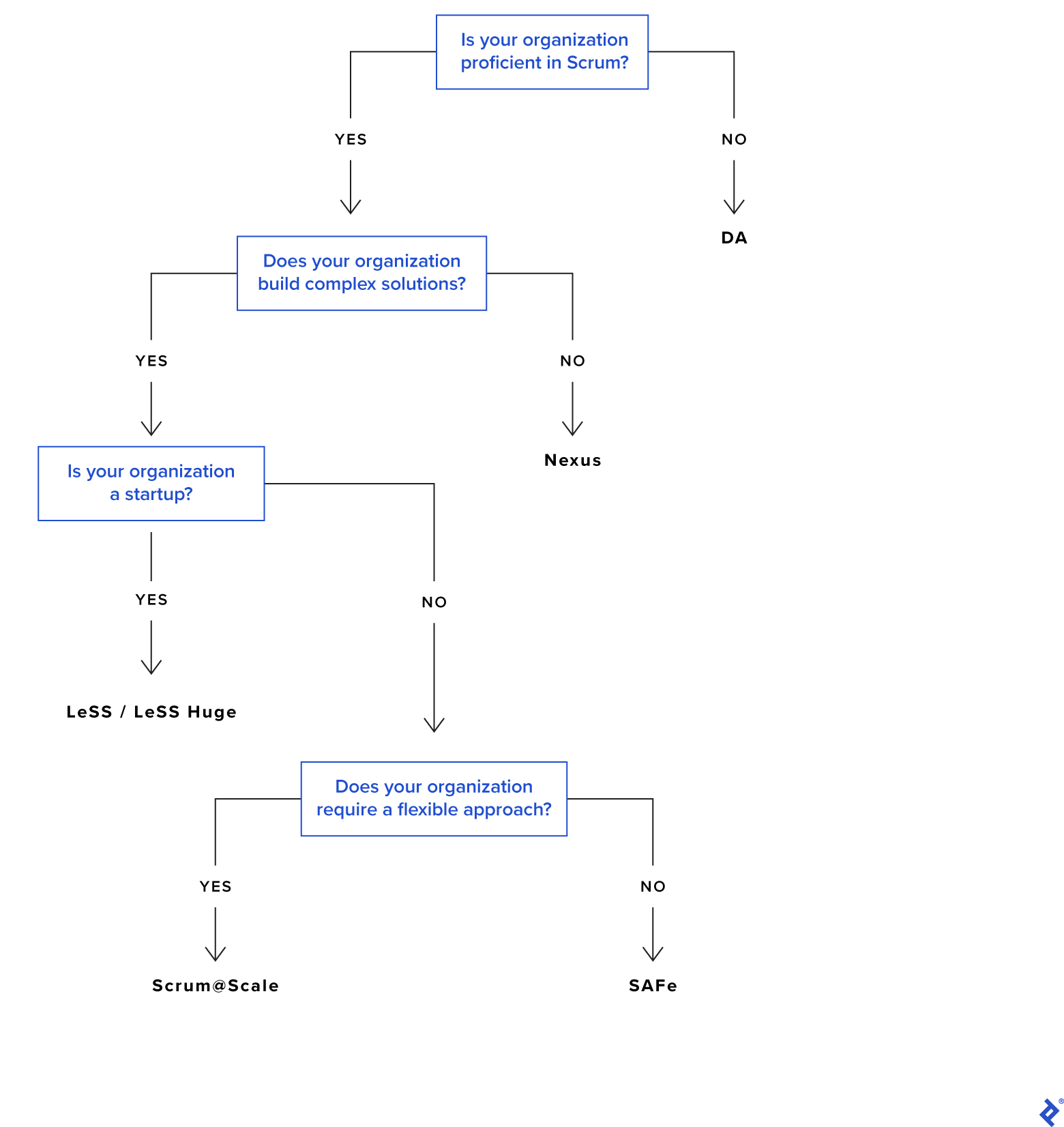
I’m confident that you’ll find the scaling Agile framework that suits your organization’s experience, approach, budget, and products among those presented here. Whichever framework you choose, it’s vital to not rush—scale incrementally to minimize disruption and plan changes well in advance.
Have you utilized these frameworks in any of your scaling activities? Tell us about your experiences in the comments section.
Read the next installment of Toptal’s Agile scaling series, “Agile Scaling: SAFe Best Practices for Scrum Masters.”
Further Reading on the Toptal Blog:
- Agile Scaling: SAFe Best Practices for Scrum Masters
- The Project Management Blueprint, Part 2: A Comprehensive Comparison of Waterfall, DAD, SAFe, LeSS, and Scrum@Scale
- Mission Driven Development
- The Ultimate Introduction to Agile Project Management
- Today’s Project Management Blueprint: A Comparison of Lean, Agile, Scrum, and Kanban
- Critical Chain Project Management: Agile’s Missing Link
- CapEx 101: Resolving the Agile vs. Waterfall Conflict With Hybrid Methodology
Understanding the basics
Scale your Agile team using a framework to expand one large team into a structure comprising several teams that work on the same value stream. This needs to be done gradually, while maintaining good cross-team communication, to ensure minimal disruption to productivity.
Select an Agile framework based on your unique work context. When choosing, consider factors such as the experience level of your team, organizational maturity, and the complexity of the solutions being built.
The four levels of the Scaled Agile Framework (SAFe) are Essential, Large Solution, Portfolio, and Full.

Kamil Imański
Alicante, Spain
Member since May 4, 2022
About the author
Kamil is an Agile project manager and Scrum master with a background in business analysis and change management. He has extensive experience leading teams and implementing Agile scaling practices at international companies, including BAE Systems, which is an FTSE100 company and the largest defense contractor in Europe. He is a certified Lean Six Sigma Black Belt, PMP, and PMI-ACP.
PREVIOUSLY AT