

Hire Golang Developers
Hire the Top 3% of Freelance Golang Developers
Hire Golang developers, programmers, and engineers on demand. Top companies and startups choose Golang engineers from Toptal for concurrent programming, microservices architecture, cloud-native development, and more.
Hire a Top Golang Developer Now
No-Risk Trial, Pay Only If Satisfied.



Hire Freelance Golang Developers

Aaron LaBrie
Freelance Golang Developer
Verified Expert in Engineering
United States
Toptal Member Since January 15, 2022
Aaron is a front-end specialist with ten years of experience as a software engineer building performant and reliable UI. Aaron has led the development of React and Golang applications serving over one million users and built features for an API with over four million users. He has advised engineering teams, taken features from MVP to highly-polished and shippable states, and overhauled legacy UI to improve performance and stability. He works well stakeholders to solve complex challenges.
Show More
Kleber Pinel Bernardo da Silva
Freelance Golang Developer
Verified Expert in Engineering
Canada
Toptal Member Since April 3, 2013
Kleber has over 17 years of successful programming experience and as an engineer manager. He is most proficient in Go and Ruby on Rails, but he enjoys mastering new technologies to solve a broader range of problems efficiently. He has thrived both as a group leader and in individual settings.
Show More
Leonhard Holz
Freelance Golang Developer
Verified Expert in Engineering
Germany
Toptal Member Since July 19, 2019
Leonhard's background spans software engineering, product management, and engineering leadership. He enjoys solving problems at the intersection of technology, product, and business — making sound architectural decisions, improving engineering execution, and helping teams build software that is fit for purpose. Recently, he has focused on AI-enabled software development and engineering effectiveness.
Show More
João Lucas Gomes de Miranda
Freelance Golang Developer
Verified Expert in Engineering
Brazil
Toptal Member Since August 23, 2018
João is a skilled back-end engineer with experience in developing and maintaining systems that are used by hundreds of millions of people. He has previously worked with languages such as Go, Python, C/C++, Java, JavaScript, and more. He has strong algorithm skills and has demonstrated an ability for learning and excelling at new technologies as needed.
Show More
Tarcisio Xavier Gruppi
Freelance Golang Developer
Verified Expert in Engineering
Brazil
Toptal Member Since December 5, 2016
With over 15 years of extensive experience in web development, Tarcisio has a solid foundation in PHP, which he worked with for several years. His current focus is leveraging Go and JavaScript/TypeScript to develop robust back-end services. Tarcisio is committed to continuously learning new technologies that can help him deliver outstanding software.
Show More
Gergely Bódi
Freelance Golang Developer
Verified Expert in Engineering
Hungary
Toptal Member Since October 10, 2016
Gergely is a developer with 13 years of experience. He specializes in Go and web technologies that supplement Go back ends. He has a strong familiarity with unit testing, SQL, and NoSQL and is also interested in cross-platform front-end development through Flutter, where he has two years of experience. During his university years, Gergely studied many programming languages. The most vital skill he acquired was the ability to learn new technologies on the fly and solve engineering problems.
Show More
Jeremiah Johnson
Freelance Golang Developer
Verified Expert in Engineering
United States
Toptal Member Since March 18, 2022
Jeremiah has been doing full-stack development for about 17 years with a focus on back-end development. He enjoys writing usable, performant APIs. Jeremiah has experience in several languages, including PHP, Scala, Go, Python, and Rust. He loves to build new things as well as continually iterate and improve.
Show More
Tochukwu Nwoko
Freelance Golang Developer
Verified Expert in Engineering
Netherlands
Toptal Member Since September 22, 2022
Tochukwu is a certified Kubernetes administrator with a wealth of experience in Linux, DevOps, Cloud Security, AWS, Python, Go, and Terraform and a proven track of excellence in designing, implementing, and maintaining highly scalable, secured, high-performing, resilient, and efficient infrastructure.
Show More
Rahul Agrawal
Freelance Golang Developer
Verified Expert in Engineering
India
Toptal Member Since April 5, 2018
Rahul has more than ten years of software development experience, which includes co-founding AxisRooms.com (used by 20,000+ hotels). He has worked extensively across the stack, and his areas of expertise include Golang, Java, Python, Android, React, React Native, and Angular.
Show More
Jay Brown
Freelance Golang Developer
Verified Expert in Engineering
United States
Toptal Member Since October 7, 2019
With more than 30 years of software development experience, Jay has spent his career designing and building enterprise back-end and mid-tier applications, protocols, and APIs. He is also skilled in deploying and operating self-hosted language models for privacy, cost control, offline operation, and infrastructure independence. He holds multiple U.S. patents, authored a Manning book on Apache OpenCMIS API development, and founded and operates radio-archive.org.
Show More
Erik Hovhannisyan
Freelance Golang Developer
Verified Expert in Engineering
United Arab Emirates
Toptal Member Since November 14, 2022
Erik is a skilled and experienced software engineer with more than eight years of experience in JavaScript and Go application development. He has strong analytical skills and experience in software development lifecycle (SDLC) and project delivery management. Erik is skilled at performing issues investigation, conducting a root cause analysis, and quickly mastering new tools and frameworks.
Show MoreDiscover More Golang Developers in the Toptal Network
Start HiringA Hiring Guide
Guide to Hiring a Great Golang Developer
Golang, or Go, is a versatile programming language that is well suited for modern app development. Go’s built-in support for concurrent programming makes it a popular choice for building high-performance applications, including cloud services, distributed systems, and high-traffic web services. This guide provides insights on hiring Golang developers, with tips on how to craft the perfect job description and examples of technical questions to ask during the interview.
Read Hiring GuideGolang Hiring Resources
Toptal in the press
... allows corporations to quickly assemble teams that have the right skills for specific projects.

Despite accelerating demand for coders, Toptal prides itself on almost Ivy League-level vetting.

Our clients


Creating an app for the game


Leading a digital transformation


Building a cross-platform app to be used worldwide


Drilling into real-time data creates an industry game changer
Testimonials
How to Hire Dedicated Golang Developers Through Toptal
1
Talk to One of Our Client Advisors
A Toptal client advisor will work with you to understand your goals, technical needs, and team dynamics.
2
Work With Hand-selected Talent
Within days, we’ll introduce you to the right Go developer for your project. Average time to match is under 24 hours.
3
The Right Fit, Guaranteed
Work with your new Golang programmer for a trial period (pay only if satisfied), ensuring they’re the right fit before starting the engagement.
EXCEPTIONAL TALENT
How We Source the Top 3% of Golang Developers
Our name “Toptal” comes from Top Talent—meaning we constantly strive to find and work with the best from around the world. Our rigorous screening process identifies experts in their domains who have passion and drive.
Of the thousands of applications Toptal sees each month, typically fewer than 3% are accepted.
Toptal Golang Case Studies
Discover how our Golang developers help the world’s top companies drive innovation at scale.
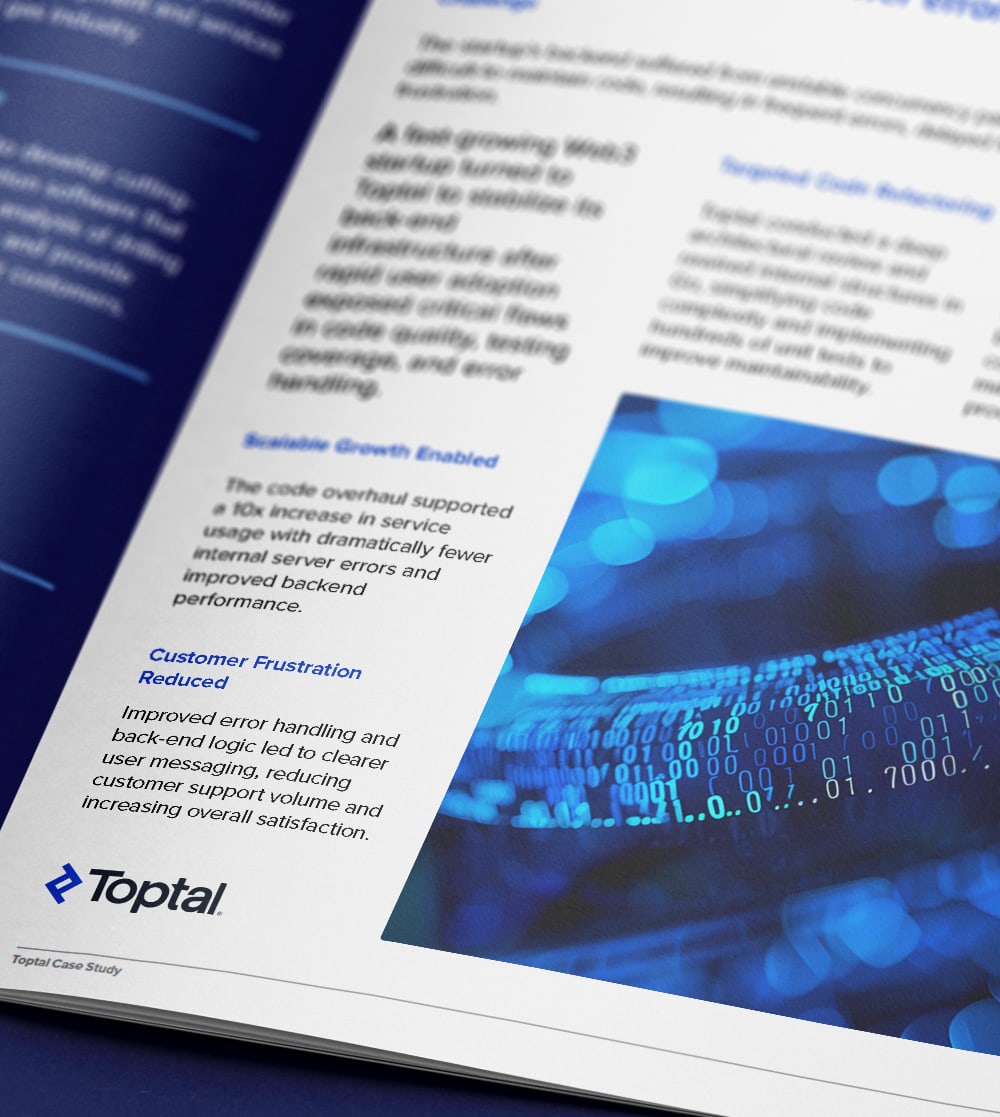
Toptal stabilizes Web3 startup backend, enabling 10x growth with fewer errors.
Challenge: A rapidly scaling Web3 startup experienced mounting backend instability as user adoption accelerated. Flawed concurrency patterns in Go, limited test coverage, and complex, difficult-to-maintain code led to frequent internal server errors, delayed feature releases, and growing customer frustration.
Solution: Toptal provided experienced Golang developers who conducted a comprehensive architectural review and refactored core backend systems. The Golang programmers simplified internal structures, corrected unstable concurrency logic, and implemented hundreds of unit tests to improve reliability and maintainability. Best practices for error handling and test coverage were introduced without disrupting live production environments.
Outcome: The stabilized backend infrastructure supported a 10x increase in service usage while significantly reducing internal server errors and improving overall performance. Clearer error reporting and more resilient logic reduced customer support volume, strengthened user trust, and positioned the startup for sustainable long-term scalability.
RELATED CAPABILITIES
- Back-end Developers
- Web3.js
- Agile Development
- Startup Development
Capabilities of Golang Developers
Harness the full potential of Golang with our skilled developers, who deliver high-performance, scalable, and reliable software solutions tailored to meet your business needs.
Concurrent Programming
Golang’s goroutines and channels support parallel task execution and concurrency, key factors contributing to its high performance. Toptal Golang developers build concurrent systems using these lightweight tools, allowing applications to run multiple tasks at once and boosting application performance under heavy workloads.
Microservices Architecture
With a microservices architecture, applications run as a network of smaller, independent services that communicate with each other. Toptal Go developers are skilled at implementing microservices, from expert architecture design to production, enabling the creation of scalable and robust applications.
Cloud-native Application Development
Cloud-native applications are specifically designed to fit into cloud environments like AWS, Azure, and Google Cloud. By using Golang’s nimble architecture and low-resource footprint, our Golang developers efficiently build cloud-native applications that perform optimally even in resource-constrained environments.
High-performance Network Services and Tools
Scalable and reliable systems are crucial for applications that support high network traffic. Toptal Go developers utilize Golang’s concurrency model and networking libraries to build network services and tools like proxies, load balances, and API gateways, ensuring effective handling of heavy traffic and complex tasks.
DevOps and Containerization
DevOps and containerization tools are integral to development, with technologies like Docker and Kubernetes frequently used to package and deploy applications. Our Go developers are experts in DevOps tools, skillfully implementing efficient application management, deployment, and scaling in cloud environments.
Advanced Testing and Continuous Integration
Before an application is put into production, every feature and function must be thoroughly tested. Toptal Golang developers maximize performance and reliability with unit and integration testing. They also automate the build, test, and deployment processes with CI/CD pipelines, ensuring a smoother development lifecycle.
Distributed Systems and Networking Protocols
Golang’s powerful foundation for managing network communication stands out when building distributed systems. Our Golang developers create efficient and scalable systems by drawing on Go’s strengths to integrate and streamline networking protocols, including WebSockets, HTTP/2, and custom TCP/UDP protocols.
Real-time Data Processing and Streaming
Being able to handle and process consistent data flows is key for building robust applications. Toptal Go developers tap into Golang’s performance characteristics, leveraging goroutines, low-latency performance, and efficient I/O to ensure high-throughput operations and reliability throughout the development life cycle.
Trusted by 25,000+ Clients Worldwide
Find the Right Talent for Every Project
Accelerate your project with versatile, expert talent. From short-term solutions to long-term collaboration, Toptal delivers impactful results.
Senior Golang Developers
Senior Golang developers bring deep technical expertise and advanced problem-solving skills to address your most complex challenges. Toptal’s rigorous vetting process provides access to professionals who combine robust technical experience with proven leadership.
Dedicated Golang Developers
Dedicated Golang developers focus exclusively on your projects, leverage advanced Golang expertise, and align with your long-term objectives to enable seamless integration and deliver high-quality outcomes.
Offshore Golang Developers
Offshore Golang developers combine exceptional expertise with competitive rates, making them ideal for scaling projects efficiently. Operating across multiple time zones, they provide global coverage and 24/7 support for time-sensitive requests.
Remote Golang Developers
Remote Golang developers offer top-tier expertise worldwide, removing location barriers to connect you with the best talent for your projects. They integrate seamlessly with distributed or hybrid teams, enabling flexible collaboration from anywhere.
FAQs
The cost associated with hiring a Golang developer depends on various factors, including preferred talent location, project complexity and scope, seniority, engagement commitment, and required skills. In the US, for example, Glassdoor’s reported total pay range for Golang developers was $108,000 to $184,000 as of June 2026. Glassdoor salary ranges are dynamically updated and may fluctuate over time. With Toptal, you can speak with an expert talent matcher who will help you understand the cost of talent with the right skills and seniority level for your needs. To get started, schedule a call with us. It’s free, and there’s no obligation to hire with Toptal.
Typically, you can hire Golang developers with Toptal in about 48 hours. For larger teams of talent or full end-to-end project delivery, timelines may vary. Our talent matchers are highly skilled in the same fields they’re matching in—they’re not recruiters or HR reps. They’ll work with you to understand your goals, technical needs, and team dynamics, and match you with ideal candidates from our vetted global talent network.
Once you select your Golang programmer, you’ll have a no-risk trial period to ensure they’re the perfect fit. Our matching process has a 98% trial-to-hire rate, so you can rest assured that you’re getting the best fit every time.
To hire the right Go engineer, it’s important to evaluate a candidate’s experience, technical skills, and communication skills. You’ll also want to consider the fit with your particular industry, company, and project. Toptal’s rigorous screening process ensures that every member of our network has excellent experience and skills, and our team will match you with the perfect Golang developers for your project.
At Toptal, we thoroughly screen our Golang engineers to ensure we only match you with the highest caliber of talent. Of the more than 200,000 people who apply to join the Toptal network each year, fewer than 3% make the cut.
In addition to screening for industry-leading expertise, we also assess candidates’ language and interpersonal skills to ensure that you have a smooth working relationship.
When you hire Go developers with Toptal, you’ll always work with world-class, custom-matched Golang developers ready to help you achieve your goals.
You can hire Golang programmers on an hourly, part-time, or full-time basis. Toptal can also manage the project end-to-end based on your specific requirements as part of our Consulting and Services offerings. Whether you hire a Golang developer for a full- or part-time position, you’ll have the control and flexibility to scale your team up or down as your needs evolve. Our Golang developers can fully integrate into your existing team for a seamless working experience.
We make sure that each engagement between you and your Golang developer begins with a trial period of up to two weeks. This means that you have time to confirm the engagement will be successful. If you’re completely satisfied with the results, we’ll bill you for the time and continue the engagement for as long as you’d like. If you’re not completely satisfied, you won’t be billed. From there, we can either part ways, or we can provide you with another Golang developer who may be a better fit and with whom we will begin a second, no-risk trial.
How to Hire Golang Developers

Verified Expert in Engineering
8 Years of Experience
Tochukwu is a Golang developer and certified Kubernetes administrator with deep expertise in building high-performance, cloud-native systems. Working across DevOps and site reliability engineering, he has designed and operated large-scale infrastructure for organizations such as Google, Swisscom, and Interswitch. His experience includes developing Go-based automation tools, architecting resilient Kubernetes platforms, and building secure, scalable CI/CD and monitoring systems across AWS, GCP, and hybrid environments.
Expertise
Previous Role
Site Reliability EngineerPreviously at

Demand for Golang Developers is Steadily Increasing
Golang, or simply Go, is an open-source programming language that was developed by Google, and designed to be simple, efficient, and reliable. It is a statically typed language, allowing it to offer performance similar to languages like C and C++. Additionally, Golang provides garbage collection, memory safety, and features a lightweight goroutine model for concurrency, making it well suited for building scalable, high-performance applications.
With the need for speed and efficiency in modern applications, the demand for Golang developers continues to grow. According to Stack Overflow’s 2025 Developer Survey, 16.4% of software engineers worked extensively with Go in 2025. Go is used by top tech companies like Meta, Dropbox, Microsoft, and Netflix. Golang’s performance, versatility, and growing ecosystem allow it to be used in a wide variety of applications and systems, including cloud and networking tools, data science, web services, DevOps automation, and microservices architectures.
This guide provides insights on how to hire the best Golang developers, with detailed tips on how to: run the hiring process, identify the attributes of a high-quality developer, write an effective job description, and interview candidates to assess their problem-solving abilities, technical skills, and fit for the position.
Challenges in Hiring Golang Developers
Hiring Golang developers can be challenging because Go is widely used for complex backend systems, cloud-native applications, distributed services, and high-performance infrastructure. Beyond basic programming skills, these environments require developers who understand system design and how architecture must adapt across use cases. In short, an effective Go developer needs to understand both the foundations of Go and the future direction of backend technology to design systems that work reliably now but are modular and flexible enough to evolve. This dichotomy creates several challenges for organizations seeking to hire Go developers.
One of the most common challenges for Go hiring managers is the limited supply of experienced Golang engineers relative to demand. Since Go is newer than languages like Java or Python, there are fewer senior Golang developers with extensive production experience in Go-dominant environments. This can make it harder to find developers who can work independently without heavy onboarding or oversight. When a skilled resource is identified, another challenge arises: can the project’s budget fairly compensate them?
Skilled Golang developers are often in demand for cloud infrastructure, fintech, DevOps, microservices, and platform engineering roles, which can raise compensation expectations. Smaller companies or startups may struggle to compete with larger organizations that can offer higher salaries, stronger benefits, and greater job security. However, when an initiative requires the benefits of Go’s speed and performance, hiring a proficient developer may be more cost-effective over time than constantly updating aging systems or choosing a less suitable language because talent is more readily available.
Finally, another challenge to consider in such a competitive niche is the assessment process. Since Go is still evolving and experienced Golang developers are already in high demand, it can be hard to find a resource not just to deliver but also to advise on the pedigree and experience of Go applicants. Strong candidates should be assessed for their ability to design adaptable, performant, and maintainable systems.
Senior Golang developers should demonstrate experience in troubleshooting performance issues, working with distributed architectures, and communicating technical recommendations and trade-offs clearly, and demonstrate their expertise through hypothetical, real-world, and past experiences.
What Attributes Distinguish Quality Golang Developers From Others?
Golang has a straightforward and easy-to-learn syntax, especially for developers who have a background in C, Java, or Python; however, there are certain skills that are particularly helpful to Go programming. An experienced candidate will not only have skills that cover software development in general, but also a deep knowledge of the core aspects of the Go language.
Concurrency: Experienced Go developers have proficiency with Go’s concurrency model and know how to implement its goroutines and channels for effective parallel processing. Candidates should have an understanding of parallel processing and how to use it efficiently to write programs that perform well on distributed systems.
Memory Management: Knowledge of Go’s memory management is crucial for the development process of high-performance and scalable applications. Candidates should know how Go handles garbage collection and memory allocation, and be able to optimize resource usage and avoid memory leaks, resulting in cleaner and more maintainable applications.
Go’s Standard Library: All candidates should have experience with Go’s versatile standard library, using its packages to perform standard tasks like I/O, templating, JSON processing, networking, and data encoding.
Dependency Management: Skilled Go developers understand Go’s module system and how to effectively manage dependencies, so there are no issues when building across environments.
Error Handling: With Go, errors are explicitly signaled or returned, enabling the code to determine the next actions. Explicit error handling has many benefits, including reducing unhandled exceptions and making the code more reliable, however, developers need to consciously check for and respond to errors. Candidates should know how to leverage explicit error handling to write code that is stable and reliable.
Build and Deployment Tools: Go developer candidates should know the differences between go build, go mod, and go run, and when to use them to maximize efficiency when compiling, deploying, and running applications.
How Can You Identify the Ideal Golang Developer for You?
Because Golang can be used for so many different types of applications, it is important to identify the complementary technologies that are relevant to a project. Skills that are required for back-end web development might be different than the ones required for infrastructure management. Top talent with experience in technologies relevant to your development project will be able to get up to speed quickly.
Complementary Technology Skills for Golang Developers
Golang Web Frameworks: Golang programmers building web applications and APIs may use frameworks such as Gin, Echo, Beego, Revel, and Buffalo, depending on the project’s needs. Gin and Echo are commonly used for lightweight, high-performance APIs because they prioritize simplicity for speed and efficient routing, making them ideal for scalable backend services. Beego, Revel, and Buffalo are often selected for larger or more structured web applications as they provide built-in tooling for MVC-style development, middleware management, routing, templating, and faster project scaffolding.
RESTful APIs: Many Go developers are called upon to develop RESTful APIs for web applications that rely on web services. Candidates should be familiar with frameworks like Gin or Echo to deliver reliable and scalable REST APIs.
Testing: Top Golang developers prioritize testing because they know that code reliability is essential for any application. Candidates should have experience with integration and unit testing using Go Testing, or third party frameworks like Testify and Ginkgo.
Database Interaction and Management: Most modern applications connect and exchange data with databases, so Go developer candidates should have working experience with SQL and NoSQL databases, as well as libraries like GORM.
Cloud Services: Many modern applications take advantage of services provided by cloud platforms such as AWS, Azure, and GCP. Golang experts leverage the cloud in a cost-effective manner, building and deploying scalable, resilient applications.
Networking Protocols: Candidates for projects that involve building networked applications should have a strong grasp of networking protocols such as HTTP, TCP/IP, and gRPC.
Containerization and Orchestration: Many modern applications are deployed in containers, simplifying distribution and improving scalability. Docker and Kubernetes are invaluable skills for any Go developer.
Front-end Technologies: For web applications where Go is used on the back end, understanding the front-end technologies will help Go developers better collaborate with the front-end team. Additionally, dedicated Golang developers who are well versed in front-end development also excels at full-stack development. Modern front-end technologies are typically based on JavaScript and include React, Angular, and Vue.js.
Determining the Required Golang Developer Expertise Level
Beyond technical requirements, the experience level of a candidate should also be considered. When developing a project from scratch, it is essential to hire a senior developer who can design the architecture for performance and scalability. It’s a good idea for startups that are building an MVP to leverage the experience of a senior developer. On the other hand, junior developers—although still honing soft skills and technical abilities—are well suited to adding new features for existing projects with clearly defined requirements.
Junior Go developers have one to three years of experience. They are skilled programmers, however, they have limited professional experience and often benefit from mentoring from a more experienced hand. Junior developers may be in the process of learning best practices for error handling, concurrency with goroutines and channels, and DevOps processes. Typical tasks for junior developers include writing and running unit tests, debugging, and implementing new features that are well defined and straightforward.
Mid-level Go developers have three to five years of experience. They have strong programming skills and are adept at using Go’s concurrency features and modules for dependency management. They are capable of advanced tasks such as designing and developing RESTful APIs, optimizing applications for performance and scalability, and interacting with and managing SQL and NoSQL databases. Mid-level developers often mentor junior developers and contribute to code reviews.
Senior Go developers have more than five years of experience. They have a deep understanding of Go, including concepts like reflection, interfacing, and advanced concurrency patterns. Senior developers lead the development of large and complex applications, designing the architecture and optimizing its performance. They also mentor team members and make decisions, both technical and strategic.
When to Hire Remote or Dedicated Golang Developers
Another important aspect to consider when identifying the right Go developer for your initiatives is whether you’ll benefit from remote, offshore, or dedicated service. Understanding how each model works can help businesses choose the right Go development support for their technical needs, internal workflows, and growth plans.
Hiring Remote Golang Developers
Often, companies hire remote Golang developers to support immediate initiatives or scale more efficiently. Remote Go engineers typically integrate with internal teams to support faster delivery timelines or broaden technical coverage through specialized skills that may be niche, legacy, or new. While availability conflicts may be viewed as a communication challenge, their oversight during periods when the business is non-operational can be beneficial, enabling incidents to be detected more quickly and upgrades to be implemented when the primary user base is less active.
Companies may also hire offshore Golang developers to optimize development costs or access specialized technical talent. When supported by thorough onboarding, detailed documentation, and organizational oversight, offshore development teams can integrate seamlessly into existing teams.
Hiring Dedicated Golang Developers
For businesses building modern backend systems with cloud-native applications, APIs, and distributed services, architectures must be flexible enough to keep up with emerging technological trends. Hiring dedicated Golang engineers can be a strategic, cost-effective way to do so. First-hand knowledge of the system’s architecture and evolution, paired with tight coordination across backend, DevOps, and infrastructure teams, allows dedicated Golang developers to efficiently support system management.
Since dedicated Golang programmers are typically assigned to a single organization, they can help teams plan iterative releases, resolve unexpected incidents, and maintain architectural consistency as systems evolve. When working with remote Go programmers, offshore Golang engineers, or junior talent, a dedicated Golang developer can be a key resource. Their accumulated knowledge of system evolution, paired with internal culture and process familiarity, gives them an edge in bringing external resources up to speed. They can also provide QA oversight and mentorship, disseminating information and guidance in a brand-tailored way.
Summary
Hire dedicated Golang developers when you need long-term architectural ownership, production stability, and rapid modernization support for your systems. Hire Golang freelancers when you need to scale delivery or expand specialized capabilities quickly, ideally with a dedicated resource helping guide onboarding, quality control, and alignment for stronger outcomes.
How to Write a Golang Developer Job Description for Your Project
With Golang being used in such a wide range of application types, the first step in writing an effective job description is defining project requirements. Identify the skills that are essential, as well as your complete tech stack. The more detailed the job description is, the more luck you’ll have attracting the right candidates.
Start with an overview of the project, its business goals, and its current status. If you do not feel comfortable disclosing the details of your project, list some similar projects so that candidates have an idea of what they’ll be working on. Summarize the complementary technologies you are using, such as your databases, cloud provider, and version control system. Include any other tools and methodologies that your development team uses, whether it’s Agile workflows for project management or continuous integration and continuous delivery (CI/CD) for deployment. Finally, list the position’s key responsibilities as well as its expected seniority level.
Talking about your company, its culture, and the onboarding experience is also important—it will help you attract the right type of candidates. Specify the location of the job and whether you are looking for onsite, hybrid, or remote Golang developers, as well as if the position is full-time or part-time. When vetting remote developers, make sure their time zone allows convenient collaboration with the rest of your team.
What Are the Most Important Golang Developer Interview Questions?
Once your job posting starts attracting candidates, you will need to interview them to assess their skill sets. You can start by asking candidates to describe previous Go projects. Then pick one of the projects and ask them to detail successes within the project in addition to things they would have done differently. Look for opportunities to transition into more technical questions to gauge their understanding of the subject. The following technical questions provide good starting points for discussions which will give you insight into a candidate’s experience and technical skills.
What are goroutines and what are they used for?
Goroutines are lightweight functions or methods that are executed independently of each other. They are often executed simultaneously with other Goroutines, and form the basis for concurrency and parallel processing in Go. An understanding of goroutines is essential for any candidate because the Golang programming language is very often selected for its parallel processing capabilities, a key contributor to scalability and performance.
What do channels in Go do?
Channels enable communication between goroutines, allowing them to synchronize their execution. They allow data to be sent and received safely between concurrent goroutines without the need for explicit locks. Channels are unbuffered by default, meaning that if data that is sent to the channel is not retrieved, additional data cannot be received. Channels can be buffered to allow multiple pieces of data to be sent before blocking. Buffering is used to decouple the timing between data production and consumption, increasing independence between goroutines and efficiency in concurrent tasks. Candidates should be familiar with channels, as they are an integral part of parallel programming in Go, and give developers much more control over the synchronization of goroutines.
How does Go manage packages and modules?
Modules are collections of related packages that can be shared with other developers. Go Modules are a good method of managing dependencies. In the application’s directory, the go.mod file defines the module’s import path and dependencies. Running go mod tidy will download and update dependencies. Because applications are typically deployed on multiple environments, candidates need to have a solid understanding of dependency management in Go.
What is the difference between a slice and an array?
Slices and arrays both represent collections, however, slices are more flexible than arrays. Slices are essentially dynamic views into an underlying array. The length of arrays cannot be changed, however, slices can be dynamically resized; for example, appending elements with the append function. Candidates should have an understanding of slices and arrays, as working with collections is a fundamental part of software development.
Explain the use of the defer statement.
When calling a function from within another function, the defer statement can be used to defer, or postpone, the execution of a function until the surrounding function finishes running. It is typically used for resource management, for example, waiting until after a file is read before closing it. Candidates should have experience using defer to manage resources and avoid resource leaks.
How do you handle data race conditions in Go?
A data race condition can occur when multiple goroutines access the same data concurrently, and at least one of them is a write. This can cause unpredictable behavior, because the times of the reads and writes are difficult to determine. To prevent data races, access to shared data must be synchronized using mutexes or with channels. With any application that uses concurrent programming, data race conditions are a risk. In order to prevent bugs that are difficult to diagnose, candidates should have a strong understanding of synchronization.
Where to Hire Golang Developers
Go development teams can be built in many different ways, including in-house hiring, outsourcing, or via on-demand, vetted talent platforms.
In-house Hiring
Larger companies typically hire at least a small number of full-time, in-house developers to build or maintain their core technology stack. Hiring is typically accomplished through technology recruiters or by placing job ads on sites like Indeed, Glassdoor, or LinkedIn.
Outsourcing
With Golang outsourcing, a firm hires external individuals or companies—sometimes located in different countries—to handle Go development tasks. This approach allows businesses to access specialized skills, reduce costs, and speed up project delivery by leveraging global talent and resources. Typically, the client and the outsourced developer establish a clear agreement outlining project expectations and timelines before work begins.
Hiring Through a Vetted Talent Platform
Sourcing freelance Golang developers through a vetted, on-demand developer platform is a good option for startups, SMBs, and enterprise-level companies. In this model, the marketplace verifies the skill set of each local or offshore developer through testing and interviews. Some platforms also offer:
- Matching services in which a talent specialist matches companies looking to hire dedicated Golang developers or freelancers with candidates who have the preferred experience, communication skills, and industry specialization
- Full-time dedicated developers for your project, as well as part-time or hourly developers who may be working on multiple projects
- The ability to hire remote, offshore Go developers, Go development teams, or individual Go consultants who will be managed by your in-house CTO or product owner
How Much Does It Cost to Hire a Golang Developer?
We’ve compiled information on Go developer salary ranges from several countries via Glassdoor, and have reported them below in US dollars. Wages in many areas consist of a base salary and additional pay, which may include cash bonuses, commissions, tips, and profit sharing. Please note that actual pricing can vary greatly, with experienced Go developers able to demand higher pay.
Country | Base pay ranges, USD |
United States | |
Canada | |
Mexico | |
Brazil (São Paulo) | |
United Kingdom (London) | |
Germany (Berlin) | |
Ukraine (Kyiv) | |
China (Beijing) | |
India (Chennai) | |
Australia |
Source: Glassdoor
Note: These numbers represent salaries as reported by Glassdoor’s proprietary machine-learning model, which uses salaries collected from its users and available government data to make pay predictions.
Why Do Companies Hire Golang Programmers?
The Go programming language is known for its versatility, efficiency, and performance. It is a preferred choice for modern programming because its built-in concurrent programming capabilities enable it to scale seamlessly for applications such as high-traffic web services, networking tools, and distributed systems. With an emphasis on reliability, performance, and scalability, companies are increasingly turning to Go. Major tech companies like Meta, Microsoft, and Netflix, as well as Google, the developers of Go, have already leveraged the language to build many of their back-end systems and tools. Both Docker and Kubernetes use Go in their source code.
Here are some real-world examples of industry leaders using Golang programmers to modernize their operations and stacks:
Fintech & Payment Platforms
Organizations hire Golang engineers for fintech and payment systems that require high-performance transaction processing, scalable APIs, and reliable distributed infrastructure made to endure heavy operational and security demands. Fintech Go developers design with security, observability, and fault tolerance in mind, as payment systems cannot afford downtime or inconsistent transaction handling. For enterprise fintech environments, Go’s performance, simplicity, and concurrency support help teams modernize infrastructure while maintaining reliability.
Use Case: American Express has publicly praised Go for driving its modernization initiatives, crediting the language’s goroutines, low garbage-collection pause times, built-in performance profiling tools, efficient resource usage, and robust online community for helping its teams reduce infrastructure overhead and streamline operations and system design.
Healthcare & Biotechnology
In healthtech and biotech environments, Go developers support applications that involve clinical data pipelines, automation, machine learning workflows, and distributed systems, where performance, stability, and security are critical. Since these systems often handle sensitive data and high-volume research operations, each initiative must be both performant and secure.
Use Case: GRAIL, a healthcare company focused on multi-cancer early detection, maintains a public Go repository containing utility packages used by many GRAIL Go tools, including packages for encrypted and compressed record-oriented files, S3 file APIs, concurrency limiting, parallel traversal, and producer-consumer queues. GRAIL is a real-world example of how Go can support data-intensive environments where secure data handling and high performance are essential.
Education & Training Platforms
Organizations hire educational Go engineers mainly to build scalable cloud-based backend services that support large numbers of concurrent users and a wealth of knowledge repositories and tools. Go’s concurrency model, performance, and simplicity make it well-suited for platforms delivering self-paced learning, cloud-based tooling, and developer-focused educational resources.
Use Case: Google provides official Go learning resources and cloud-based training materials through its Google Cloud and Go developer platforms. In a true case of meta irony, Google maintains extensive Go-based tooling, libraries, and sample applications used to teach developers how to build scalable cloud-native systems with Go.
Because of Go’s proven track record, more and more companies are integrating Go into their technology stack and looking to hire Go developers who can build scalable, high-performing systems.
Featured Toptal Golang Publications





Top Golang Developers Are in High Demand.